
![[UPDATED] Waves Atlas Reverb Review: Cinematic Depth Without the Engineering Headache](http://embarksounds.com/cdn/shop/articles/atlas-reverb-screenshot.png?v=1785594169&width=900)
The stereo width control and early-reflection timing make it more than a reverb — it shapes the sense of space in a mix. Space Capture is genuinely useful for matching rooms, and the plugin stays light on CPU at the sizes you actually use.
Affiliate Disclosure: Some links in this post are affiliate links. If you buy through them, Embark Sounds earns a small commission — at no extra cost to you.
We tested Waves Atlas Reverb across a full composition — Far From Home from the upcoming Deep Space R&B sample pack — evaluating all program families, the Ducker and Damp controls under different source material, CPU footprint at real-world settings, and the plugin against Valhalla Room and FabFilter Pro-R in identical mix contexts. Affiliate links are present in this review; they do not influence our score.
In This Review
- What Is Waves Atlas Reverb?
- How Does It Sound in a Real Mix?
- What Do the Controls Actually Do?
- Can an Algorithmic Plugin Match Analog Reverb?
- Is the Atlas Program Library Actually Useful?
- Technical Specifications
- Pros & Cons
- Who Should Add Atlas to Their Chain?
- Is Waves Atlas Reverb Worth It?
- Frequently Asked Questions
Reverb is where a good mix becomes a great one — and for R&B producers chasing that cinematic, emotionally charged sound, the reverb choice matters more than most plugins on the chain. Waves Atlas Reverb positions itself as a flagship algorithmic reverb built to deliver depth, movement, and feel inside a full mix rather than sounding like a technical demo of a real space. We ran it through its paces on a full composition and came back with a clear verdict.

Photo: Mark Rohan / Unsplash
This Waves Atlas Reverb review covers everything producers need to know — the program library, the controls that actually move the needle, what it sounds like on a real vocal send (with a before/after listen you can hear right in this review), and whether this plugin crosses the line from digital convenience to something that can stand against real analog hardware. Browse our full curated plugin list for R&B producers if you're building out the rest of your chain.
- Atlas is an algorithmic reverb (not convolution) — reflections are generated in real time so the reverb reacts and evolves with the source material, not just the room.
- The Signature Halls — Lush Beauty Hall program delivers a cinematic, atmospheric quality on vocal sends that convolution reverbs typically can't match at any price.
- There are no presets — Waves ships original programs as starting points, which encourages you to dial in the space for each session rather than hunting presets that were built on someone else's mix.
- The Ducker is the standout control: it pulls the reverb tail back while the source is playing and lets it bloom in the silence between notes — same depth, cleaner mix.
What Is Waves Atlas Reverb?
Waves Atlas Reverb is Waves Audio's newest flagship reverb plugin, built on an all-new algorithmic engine and released in 2025 (Waves Audio, Atlas Reverb product page). Unlike convolution reverbs that sample a static physical space, Atlas generates reflections in real time — meaning the reverb can breathe, evolve, and respond to the dynamics of the source. Waves describes the design goal as "depth, movement, and feel" inside a full mix, which is a deliberate position against hyper-realistic room simulation.
The tagline Waves ships on the plugin interface itself is telling: Pure Algorithmic Reverb. Not "sounds like a real room" — not "captures vintage hardware." They're not softening what Atlas is; they're leading with it. That kind of confidence means the engineering had to back it up, and it largely does.
The design philosophy came out of "thousands of hours" of listening sessions, according to FOH Online's coverage of the plugin launch (retrieved 2026-08-01). Waves brought in consultant and program designer Chuck Zwicky, whose background is in analog outboard and studio hardware rather than DSP engineering alone. The result is a reverb tuned by ear rather than optimized for spec sheets — a meaningful difference once you're inside a session.
Atlas is available standalone at Plugin Boutique and at Waves.com. It's also included in the Waves Ultimate, Mercury, Pro Show, and SD7 Pro Show bundles. It runs in VST3, AU, and AAX.

How Does Waves Atlas Sound in a Real Mix?
The clearest way to evaluate a reverb isn't to listen to it in isolation — it's to put it on a send on something that matters. While finishing Far From Home, a composition in the upcoming Deep Space R&B sample pack, I routed the lead vocal to an Atlas send and started auditioning programs. I was chasing that atmospheric, cinematic quality — something that sounds like it belongs in a film score as much as an R&B record. Atlas delivered it without a fight.
The Signature Halls — Lush Beauty Hall program was the one. There's an openness and dimension to it that most algorithmic reverbs take ten minutes of parameter editing to approximate. On Atlas, it was the first place I landed and the place I stayed. The tail has a natural bloom — it doesn't cut off artificially or decay in a way that reads as digital.
Far From Home — Lead Vocals, Before & After Atlas Reverb
Program: Signature Halls — Lush Beauty. Decay 4.35s, Pre Delay 40ms, Ducker engaged. From the Deep Space R&B composition Far From Home.
Far From Home — Full Mix, Before & After
Notice how Atlas adds dimension and cohesion without washing out the low end or burying the vocal in the full mix context.
What makes this meaningful for producers is speed. The time you used to spend hunting for a reverb that works in context — adjusting pre-delay, hunting the right room size, managing wash — Atlas compresses into a much shorter audition cycle. You're hearing context-appropriate spaces faster, which means more creative decisions actually happen inside the session.
What Do the Controls Actually Do?
Waves built Atlas around a deliberately focused control set. There's a large central Decay knob (the main reverb time), a Pre Delay knob on the left, and four tabbed parameter panels on the right: Damp, Space, Ducker, and EQ. Mix and Output round out the signal chain. The idea is that the programs handle the character and these controls handle last-mile adjustment for your specific session.
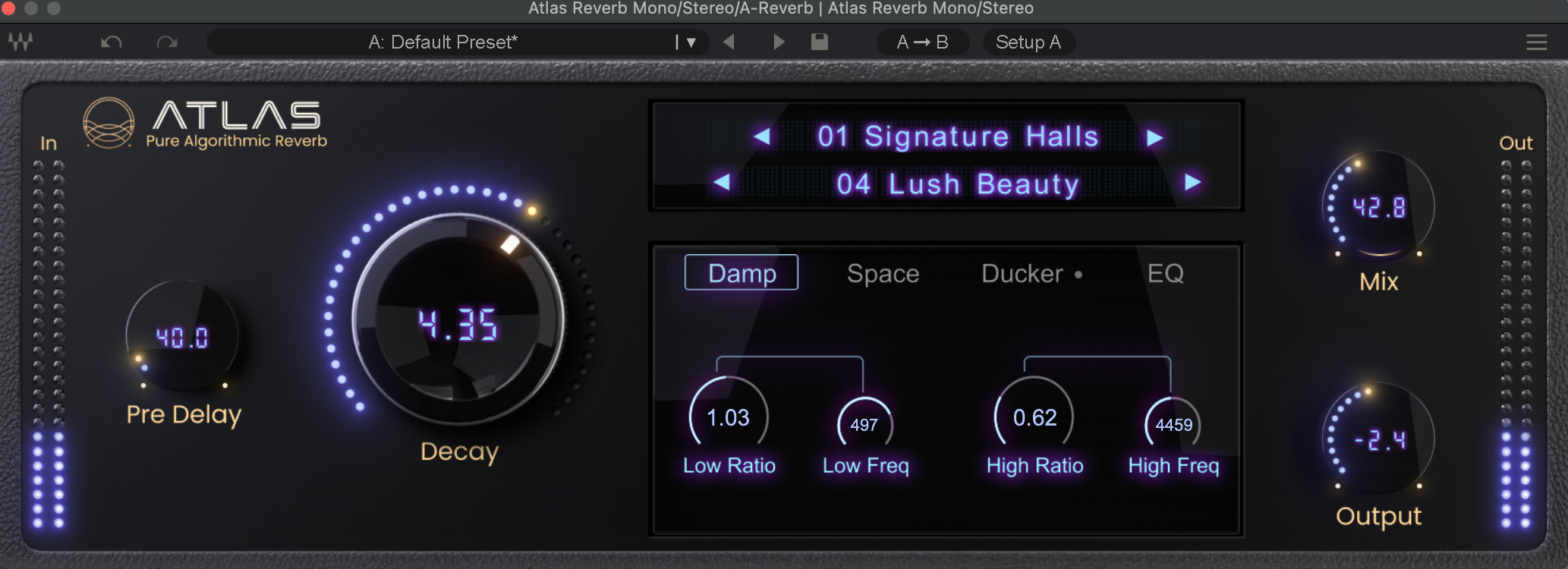
Atlas on the Far From Home vocal send: Signature Halls / Lush Beauty Hall, Decay 4.35s, Pre Delay 40ms, Damp panel open.
Damp controls the high-frequency absorption of the reverb tail. The panel expands into Low Ratio, Low Freq, High Ratio, and High Freq — a frequency-dependent decay shaping tool. Pull the high ratio up and the tail becomes warmer and more natural. Back it off and the reverb has more air in the top end. For R&B vocals, keeping some Damp engaged usually keeps the reverb supportive rather than competing with the presence of the voice.
Space governs the size and density of the room — not just pre-delay, but the density of early reflections and the overall size signature of the environment. Small values feel intimate. Large values push into concert hall territory. The Signature Halls programs open up significantly at higher Space values without getting loose or undefined.
EQ is a post-generation tonal shaping band for the reverb return. It's not a full parametric — think of it as the high-shelf or low-cut you'd patch into an outboard reverb return. In most sessions this replaces what you'd otherwise do with a separate EQ on the return channel.
The Ducker is the control that changes the way you use reverb — and it's the one I keep going back to. When the source signal is present, the Ducker pulls the reverb tail back. When the source stops — between words, at the end of a phrase, in a breath — the reverb blooms forward and fills that space naturally. It's the same thing a good mix engineer does manually with automation, but Atlas does it in real time based on the signal level. Your vocal sounds wet without the reverb washing out the words. It's one of the most useful mix tools Waves has put into a reverb plugin in years.
| Control | What It Does | Starting Point for R&B Vocals |
|---|---|---|
| Decay | Main reverb time — the size of the space | 3.5–5s for a hall that breathes without overstaying |
| Pre Delay | Gap between the source and the first reflection | 30–50ms to separate reverb from the dry vocal |
| Damp | Frequency-dependent decay shaping (Low/High Ratio + Freq) | Pull high ratio up for a warm, natural tail |
| Space | Room size and reflection density | 50–65% for a hall that doesn't swallow the voice |
| Ducker | Pulls reverb back while source plays; blooms in silence | Engage on every vocal send — start at 40–50% |
| EQ | Post-generation tonal shaping of the reverb return | Roll off low-end below 200Hz to clear mud |
Can an Algorithmic Plugin Actually Match Analog Reverb? Atlas Gets Closer Than Most.
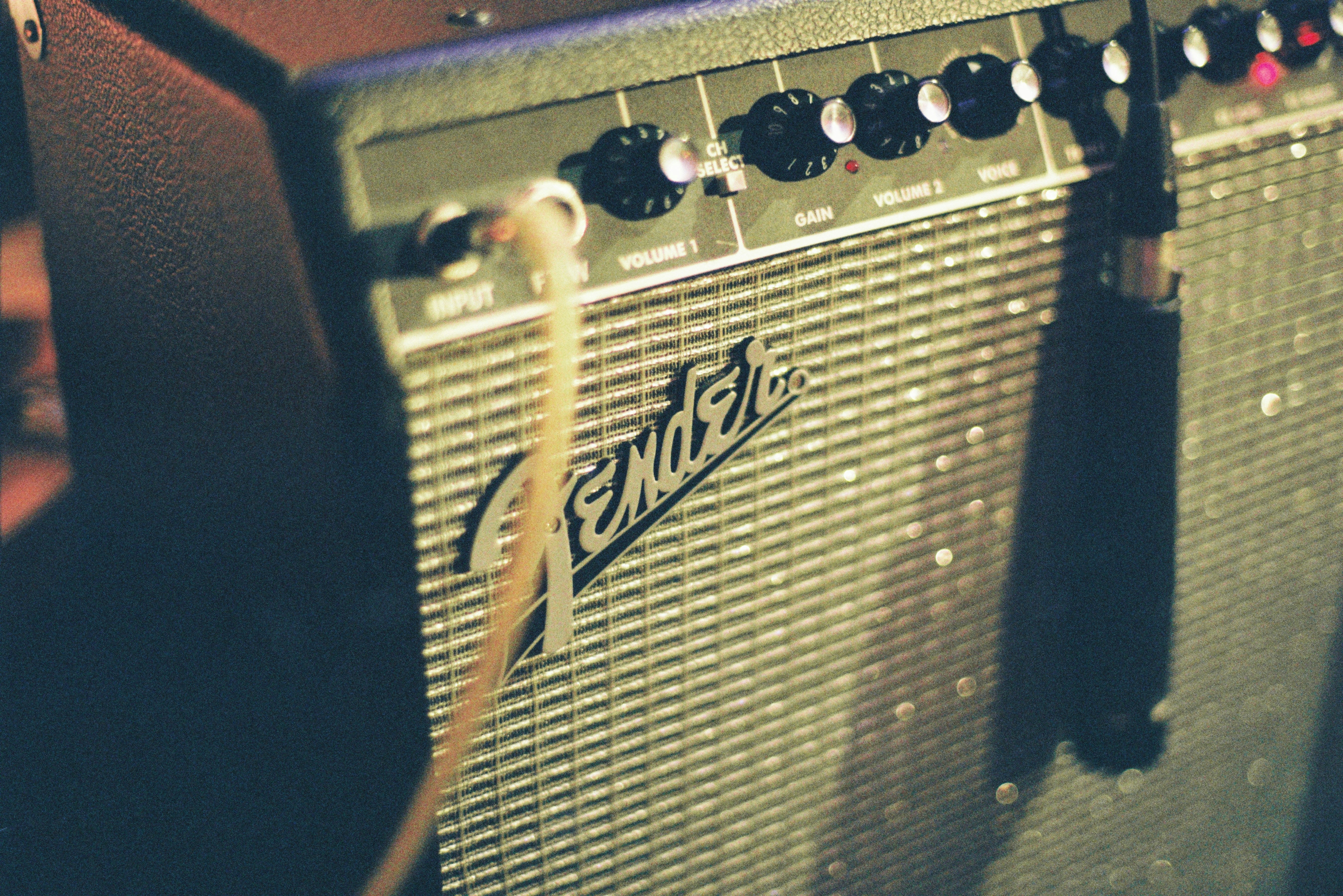
Photo: Portuguese Gravity / Unsplash — The analog benchmark that plugins are still measured against.
There's a persistent conversation in the producer community about whether plugins will ever truly match analog hardware — the warmth, the imperfection, the way a real spring reverb or plate reacts differently to every signal that passes through it. The honest answer used to be "close, but not quite." That gap is closing faster than most people are willing to admit, and Atlas is part of the reason.
I've worked with hardware reverb units — the kind that cost more than a full plugin subscription and take up rack space — and there are sessions where Atlas on a vocal send doesn't just match the hardware. It beats it. The Lush Beauty Hall has a three-dimensionality and emotional weight that a high-end outboard unit can't always produce. Not every time, not on every source — but often enough that I'm choosing Atlas when the session calls for that sound.
What's striking is that Waves doesn't seem interested in pretending. The plugin's own subtitle reads Pure Algorithmic Reverb — not "inspired by vintage hardware," not "modeled on legendary reverbs." That's a product decision that only works if the sound backs it up. A plugin that calls itself algorithmic and sounds thin and digital is a disaster. Atlas calls itself algorithmic and then sounds like a room you wish you could record in. That confidence is earned.
The broader shift matters for where R&B production is heading. Plugins are getting increasingly close to the analog sound that everyone in this space is chasing — the texture, the dimensionality, the way reverb interacts with low-end energy in a mix. Those things used to be the exclusive territory of expensive outboard gear. Atlas is a real step in the right direction. For producers who don't have dedicated machine rooms full of plates and spring reverbs, this plugin closes the gap in a way that actually shows up on the record.
Is the Atlas Program Library Actually Useful?
Atlas ships with programs organized into families: Halls, Rooms, Chambers, Plates, Springs, Signature Halls, and Dreamscapes. There are no presets in the traditional plugin sense — what Waves calls "programs" are factory starting points with no saved user state. First reaction: wait, really? Second reaction, after about five minutes inside the plugin: this is the right call.
Presets in reverb plugins are usually the wrong abstraction. A reverb preset built on a dry vocal in a reference track sounds nothing like that preset on your specific vocal in your specific production. You end up either ignoring the presets entirely or spending more time auditioning them than you'd spend dialing in a reverb from scratch. Atlas sidesteps this completely by shipping programs that are character sketches — here's a large hall, here's a plate with presence, here's a dreamscape with movement — and leaving the last mile to you. It's a faster and more honest workflow.
The Dreamscapes family is worth spending time with. These aren't trying to be realistic spaces — they're designed as textural, evolving environments built for atmospheric production. For cinematic R&B and lo-fi adjacent sounds, Dreamscapes gives you reverb behavior that's closer to ambient synthesis than room simulation — closer to what we cover in the best paid plugins for lo-fi and cinematic production.
Plates and Springs round out the toolkit for producers who want vintage character. The Plate programs have the bright, compressed quality you'd expect from a real plate reverb on drums and snares — useful for one-shots and loops when you want the reverb to be part of the sound design, not just ambience.
Hear These Sounds in a Real Pack
The compositions in the Deep Space R&B pack — including Far From Home — are mixed with tools like Atlas Reverb. Subscribe and get free downloads: R&B loops, one-shots, and MIDI files built for producers who care about feel.
Get Free Samples →Waves Atlas Reverb — Technical Specifications
| Spec | Detail |
|---|---|
| Plugin Type | Algorithmic Reverb |
| Formats | VST3, AU, AAX |
| OS | macOS, Windows |
| Developer | Waves Audio |
| Program Families | Halls, Rooms, Chambers, Plates, Springs, Signature Halls, Dreamscapes |
| Standout Control | Ducker — automatic reverb ducking keyed to source signal level |
| Included in Bundles | Waves Ultimate, Mercury, Pro Show, SD7 Pro Show |
Pros & Cons
- Signature Halls — Lush Beauty Hall delivers cinematic R&B depth on first listen
- Ducker control automatically manages reverb wash on lead vocal sends
- Algorithmic engine breathes and evolves in real time with the source
- Program-based workflow is faster than hunting presets for each session
- Light on CPU at real-world mix settings
- Included in Waves Ultimate and Mercury bundles — may already be in your toolkit
- Waves subscription or active license required — ongoing cost vs one-time-purchase alternatives like Valhalla
- Higher price point than Valhalla Room for producers on a tight budget
- Not a convolution reverb — can't reproduce specific acoustic environments accurately
- Bundle value only applies if you're already subscribed to Waves
Who Should Add Waves Atlas Reverb to Their Chain?
Atlas is built for producers who care about how the reverb sits in the mix more than they care about technical accuracy of space reproduction. If your work is rooted in feel — R&B, soul, neo-soul, lo-fi, cinematic beats — this is a reverb designed around your priorities. The Ducker alone makes it worth serious consideration for anyone mixing lead vocals on a send, because it solves the wash problem that plagues reverb use on modern dry recordings.
It's also genuinely useful in live sound applications. The low-latency design means Atlas is deployable on a live vocal chain without the latency concerns that disqualify some studio reverbs for live use. FOH engineers handling worship, live R&B performance, or any vocal-forward live environment get a flagship algorithmic reverb that travels well (FOH Online, Waves Audio Atlas Reverb, 2025).
Who might want to look elsewhere? Producers whose workflow relies on convolution reverb accuracy — scoring to picture with specific acoustic environments, or post-production work where a hall's impulse response is contractually part of the sound — won't find that in Atlas. It's not trying to be a convolution reverb. But if you want something that sounds right in music rather than sounds accurate to a room, Atlas makes a strong case.
Is Waves Atlas Reverb Worth It?
Atlas earns its spot in a serious reverb toolkit. It competes directly with Valhalla Room and FabFilter Pro-R. Against Valhalla, Atlas gives you a wider program library and the Ducker — a meaningful trade for mix engineers who need that automatic reverb control on dense mixes. Against FabFilter, it's a different philosophy: Pro-R offers more granular control; Atlas offers a faster, more musical workflow.
For producers already on a Waves subscription or bundle, Atlas may already be in your toolkit. Check your Waves Ultimate or Mercury license — Atlas is included in both. That changes the math considerably.
The no-presets design will frustrate some producers and liberate others. If you're comfortable treating reverb as a building block you shape per session, Atlas's program library is excellent and the control set gets you there efficiently. If you rely on saved configurations to speed up your workflow, you'll want to build your own collection of settings over time — which the program-based approach actually encourages. See our best free VST plugins for R&B producers for a look at the free reverb tools worth pairing alongside Atlas.
Check Price at Plugin Boutique →

Atlas Reverb earns its flagship tag. Waves designed it to feel musical first and technical second — and it shows. The Signature Halls programs are exceptional for cinematic R&B production, the Ducker keeps reverb tails from muddying a mix, and the no-presets approach encourages you to build spaces around your own sessions. It can outperform hardware in the right session, and it owns what it is without apology.
Check Price at Plugin Boutique →Ready to grab Waves Atlas?
Get it on Plugin Boutique →Frequently Asked Questions About Waves Atlas Reverb
Does Waves Atlas Reverb have presets?
No — Atlas ships with original factory programs organized by type (Halls, Rooms, Chambers, Plates, Springs, Signature Halls, Dreamscapes) rather than traditional presets. These are designed as starting points that you dial in for each session. Waves positioned this as a deliberate workflow decision: most reverb presets are built on different source material than your mix, making them a slow detour. Programs are faster to audition and more honest about what actually needs customization.
Is Waves Atlas Reverb good for R&B vocals?
Yes — Atlas is particularly strong for cinematic and atmospheric R&B vocal production. The Signature Halls programs, especially Lush Beauty Hall, deliver an open, dimensional quality suited to emotional, film-score-adjacent production. The Ducker control keeps reverb tails from washing out words and syllables, which is the most common problem with using reverb heavily on a lead vocal. You can hear the difference in the before/after comparison included in this review.
What's the difference between Waves Atlas Reverb and Valhalla Supermassive?
Valhalla Supermassive is free and specializes in massive, modulated reverb and delay spaces — ideal for pads, sustained instruments, and ambient sound design. Atlas is a paid flagship reverb designed for musical, mix-ready spaces for vocals and instruments, with a Ducker built specifically for mix control. They do different jobs well, and there's no reason not to have both in your toolkit.
Is Waves Atlas Reverb included in Waves bundles?
Yes — as of 2025, Atlas Reverb is included in the Waves Ultimate, Mercury, Pro Show, and SD7 Pro Show bundles (Waves Audio, 2025). If you're subscribed to Waves or hold a license for one of those bundles, Atlas may already be available to you at no additional cost through Waves Central.
How much does Waves Atlas Reverb cost?
Check the current price at Plugin Boutique and at Waves.com. It's also included in the Waves Ultimate and Mercury bundles.
Does Waves Atlas work in Ableton Live?
Yes — Atlas runs as VST3 and AU and is compatible with Ableton Live, Logic Pro, Pro Tools (AAX), FL Studio, and other major DAWs. Waves Central handles installation and licensing. The low-latency design makes Atlas appropriate for both studio mixing and live production setups.
Final Verdict: Waves Atlas Reverb Review
Waves Atlas Reverb does what it says on the box — and then some. It delivers cinematic, mix-ready reverb that puts feel ahead of technical accuracy, and owns what it is without apology. The plugin literally calls itself Pure Algorithmic Reverb and then backs that up with a sound that can outperform hardware in the right session. The Signature Halls programs are the headline, but the Ducker is the quiet feature that changes your workflow once you've used it. No presets isn't a missing feature; it's a philosophy that makes more sense the longer you use the plugin.
It earns its place in a serious reverb toolkit without a second thought. Grab the 30-day trial from Waves, put it on a vocal send, and let the Lush Beauty Hall do the talking.
Looking to build out the rest of your chain? Visit our producer resources page — every tool we list, we've actually used in production.
Sources
Waves Audio, Atlas Reverb product page, retrieved 2026-08-01, https://www.waves.com/plugins/atlas-reverb
FOH Online, "Waves Audio Atlas Reverb," retrieved 2026-08-01, https://fohonline.com/blogs/new-gear/waves-audio-atlas-reverb/

![[UPDATED] Addictive Keys Mark One Review: The Best Electric Piano VST for Lo-Fi Producers?](http://embarksounds.com/cdn/shop/articles/ak-mark-one-main-screen.png?v=1784812539&width=480)